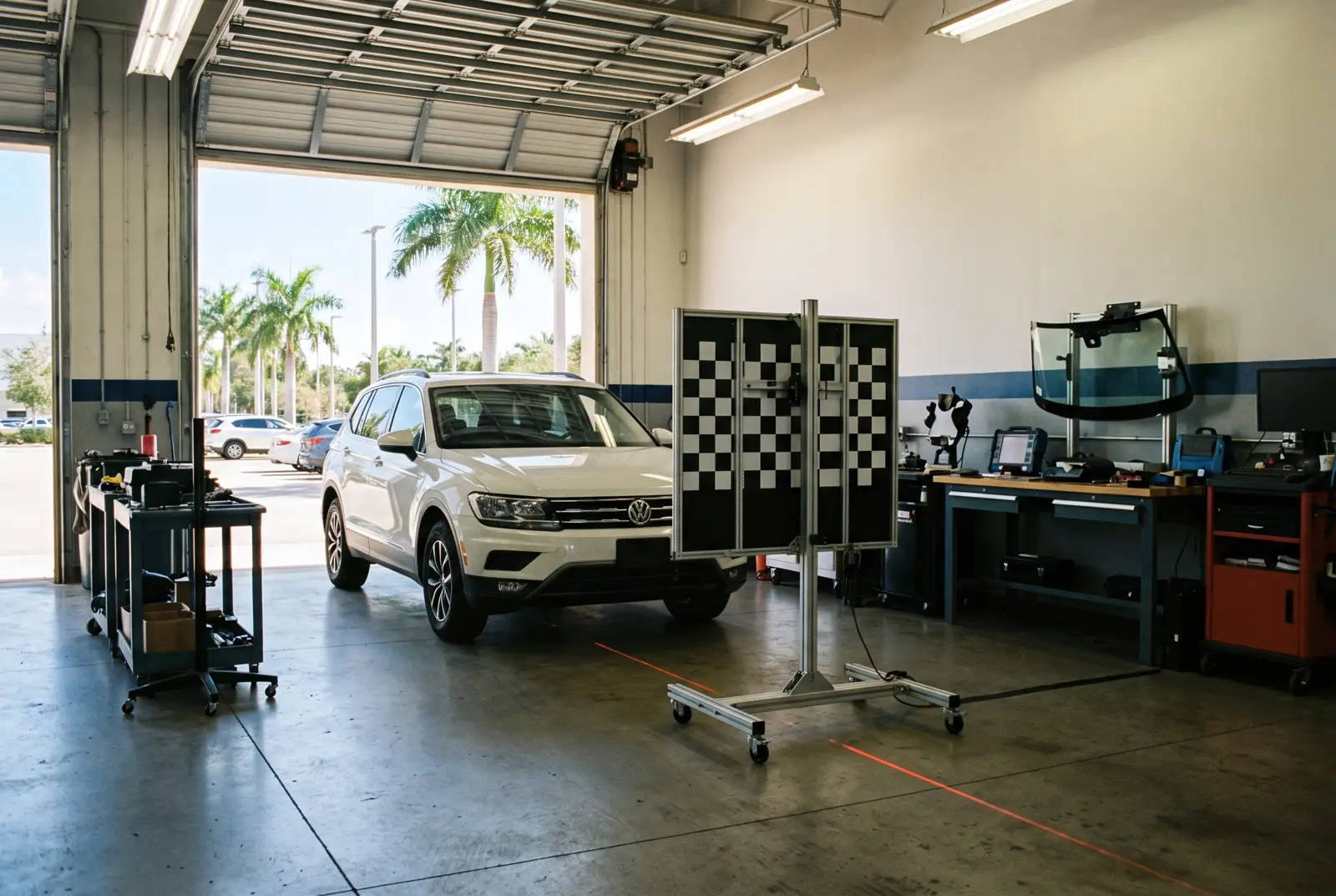
ADAS camera calibration in West Melbourne re-aims the camera behind your windshield after new glass goes in, so lane-keep assist, automatic emergency braking and adaptive cruise control see the road the way the vehicle maker intended. West Melbourne Auto Glass plans calibration as part of the windshield estimate, so your safety systems are checked before you rely on them.
ADAS calibration starts with a scan of the vehicle’s computer to see which driver-assist systems are installed and whether any fault codes are stored. A static calibration places a printed target at a measured distance in front of the parked vehicle while the camera learns it. A dynamic calibration has the vehicle driven on clearly marked roads at a set speed while the camera relearns the lane lines. Some vehicles need one method and some need both.
The camera is mounted to the glass, so new glass changes its angle.
Lane or collision lights after an install mean the camera needs attention.
A camera aimed slightly off can steer you toward the lane line.
Ride height and wheel angle changes affect what the camera sees.
A bump to the front of the vehicle can shift camera and radar aim.
Collision alerts that come too late are a sign the camera is misaligned.
The forward camera sits in a bracket bonded to the inside of the windshield, right behind the mirror. Every windshield sits a tiny bit differently in its frame, and a change of a fraction of a degree moves where the camera is looking far down the road. The vehicle’s computer cannot correct for that on its own, so the camera has to be calibrated to the new glass.
ADAS calibration cost depends on the vehicle and the method the vehicle maker requires. Static calibration needs level floor space and targets, dynamic calibration needs a road drive in good conditions, and some vehicles need both. Many insurers include calibration as part of a covered windshield claim. Call with your year, make and model for a free estimate.
| Static | Dynamic | |
|---|---|---|
| How it works | Targets set in front of the parked vehicle | Camera relearns during a test drive |
| Space needed | Flat, level floor with room for targets | Well-marked roads at steady speed |
| Weather | Covered, well-lit space | Clear lane lines and decent weather |
| Who decides | The vehicle maker’s repair procedure | The vehicle maker’s repair procedure |
Calibration usually follows a windshield replacement, so the two are estimated together. We also handle windshield replacement and chip & crack repair, or you can see all auto glass services in West Melbourne.
Look for a camera housing behind the rearview mirror at the top of the windshield, or check whether your vehicle has lane departure warning, lane-keep assist, automatic emergency braking or adaptive cruise control. Any of these usually means a windshield camera that needs calibration after new glass.
Most vehicle makers say yes. Their repair procedures call for calibration whenever a windshield with a camera bracket is replaced. Skipping it can leave the camera aimed slightly wrong, which makes warnings late or lane-keep steer the wrong way.
Calibration usually takes 30 minutes to an hour, depending on the vehicle and the method. Some vehicles finish a dynamic calibration in a short drive, while others need a longer run on clearly marked roads like I-95.
Yes. You get a record showing the calibration was completed, which helps with your insurance claim. Keep it with your vehicle paperwork.
Call for a free estimate. We confirm the right glass and the right fix before anyone drives out.
Call (321) 339-1784 Now